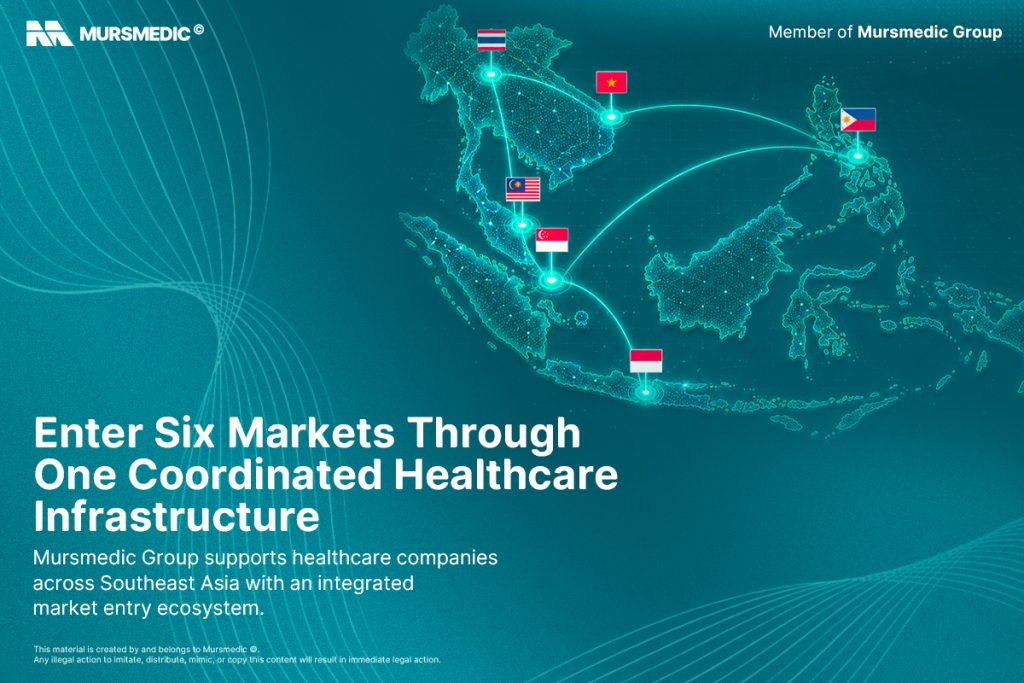


Expanding one healthcare product into six Southeast Asian markets can involve six regulatory assessments, local operating structures, registration timelines, and groups of service providers.
The main difficulty is keeping those elements aligned. When each country is managed separately, teams may duplicate work, use inconsistent product information, and lose visibility over the regional plan. Regulatory, importation, and commercial activities can also move on different timelines.
A coordinated healthcare infrastructure gives companies one regional framework for managing country-specific requirements. Local execution remains essential, while information, responsibilities, and launch priorities stay connected.
Southeast Asia Is Not a Single Regulatory Market
Indonesia, Malaysia, Singapore, Thailand, the Philippines, and Vietnam each have their own regulatory authority, legal framework, registration process, local entity requirements, and importation rules.
Medical devices provide a clear example. The ASEAN Medical Device Directive establishes shared principles and common technical documents. Product registration and local licensing, however, remain under the authority of each Member State.
Pharmaceuticals, cosmetics, health supplements, food, and household health products also follow national requirements. Regional expansion therefore requires several local pathways managed under one consistent program.
Where Fragmented Market Entry Causes Problems
Inconsistent product information
Different providers may work from different model lists, claims, labels, or intended-use statements. These inconsistencies can affect classification, registration scope, and authority responses.
Gaps between compliance and operations
Product registration must connect with license holding, labeling, importation, customs documentation, warehousing, distribution, and post-market responsibilities. Poor handovers between these functions can delay a launch after approval has already been secured.
Limited regional visibility
Separate reporting formats make it difficult to compare progress across countries. Management may not have a clear view of document gaps, authority questions, upcoming fees, or markets that need escalation.
Misaligned timelines
Registration may progress before the local importation structure is ready. Inventory may also arrive before labeling, permits, warehouse arrangements, or distributor responsibilities have been finalized.
These issues add coordination work and can delay commercial activity.
What a Coordinated Healthcare Infrastructure Connects
Coordination starts with a shared regional plan, controlled product information, defined local owners, and consolidated reporting. Each country team then applies the relevant local requirements within that structure.
1. Regulatory and Quality Consulting
An early assessment should cover product category, classification, claims, available evidence, dossier readiness, and country-specific gaps. It should also identify local testing, labeling, language, quality, or facility requirements.
A cross-country assessment shows which documents can support several markets and which materials require local preparation.
2. Country-Specific Product Registration
Each submission follows its national pathway. A common product list, intended-use statement, claims matrix, and document index help keep the applications consistent.
Central tracking also gives the regional team a clearer view of submission status, authority questions, pending documents, and expected approvals.
3. Independent License Holding
Some markets and product categories require a local license holder, marketing authorization holder, or authorized representative. That entity may be responsible for authority communication, renewals, change notifications, vigilance, recalls, local labeling, and other post-market duties.
Where regulations permit, an independent structure can separate regulatory ownership from the commercial distributor. This gives the product owner greater flexibility when managing distributor relationships.
4. Importation and Customs Support
Regulatory approval is one requirement within a larger supply process. Import permits, shipping documents, product labels, customs classifications, consignee arrangements, and warehouse readiness must be checked before goods move.
Early importation planning reduces the gap between market authorization and product availability.
5. Distribution Infrastructure
The distribution plan may include distributor screening, warehousing, order fulfillment, 3PL or 4PL support, inventory control, traceability, and post-market communication.
Connecting these activities with the regulatory and license-holding structure creates clearer ownership throughout the commercial process.
6. Supporting Healthcare Services
Regional projects may also require due diligence, partner assessment, translation, regulatory training, market research, government affairs, or technical-document preparation. Including these needs in the main plan helps companies budget and schedule them earlier.
Local Expertise Across Six Markets
Mursmedic Group supports healthcare market entry across:
- 🇮🇩 Indonesia
- 🇲🇾 Malaysia
- 🇸🇬 Singapore
- 🇹🇭 Thailand
- 🇵🇭 The Philippines
- 🇻🇳 Vietnam
Local experts in each market can work from the same regional direction, share relevant information, and identify dependencies between countries. This gives companies a more consistent view of progress while preserving local regulatory judgment.
Mursmedic Group has more than 15 years of experience across these six markets through five specialized companies. The Group reports supporting more than 100 healthcare companies, registering over 10,000 products, and securing more than 1,000 certifications. Its service ecosystem covers regulatory and quality consulting, product registration, independent license holding, importation, distribution, and supporting capabilities.
How Coordination Improves Regional Expansion
| Common Regional Issue | Coordinated Approach |
|---|---|
| Different product information across countries | Use one controlled product list, claims matrix, and document index |
| Separate reports from local providers | Consolidate progress, risks, fees, and next actions |
| Approval issued before supply readiness | Plan registration, importation, labeling, and warehousing in parallel |
| Unclear regulatory and commercial ownership | Define the roles of the product owner, license holder, importer, and distributor |
| Markets launched without clear priority | Sequence countries based on commercial value and regulatory readiness |
Five Steps for a Scalable Regional Strategy
1. Set the commercial priorities
Define the products, countries, target customers, preferred launch timing, and intended distributor model.
2. Assess each country
Confirm product classification, regulatory pathway, local entity requirements, dossier gaps, estimated timeline, government fees, and post-market responsibilities.
3. Control the core product information
Prepare a master product list, claims matrix, model configuration, document index, and version-control process for all country teams.
4. Connect regulatory and supply planning
Assign responsibility for license holding, labeling, importation, customs, warehousing, distribution, and post-market activities before submission.
5. Manage the region through one reporting structure
Use consistent status reporting, decision owners, escalation routes, and scheduled cross-country reviews.
A Connected Strategy for Six Local Pathways
Each Southeast Asian market still requires local assessment and execution. Central coordination helps reduce duplicated work, control product information, align operational dependencies, and improve regional visibility.
Companies can then manage six country pathways as one regional program without overlooking the requirements of each market.
Planning to Expand Across Southeast Asia?
Connect with Mursmedic Group to develop a coordinated market-entry strategy across Indonesia, Malaysia, Singapore, Thailand, the Philippines, and Vietnam.
Our team can assess your target markets, identify the relevant pathways, and coordinate the required stages of commercialization.
Connect with Mursmedic Group:
Email: marketing@mursmedic.com
Phone: +62 811-1929-2933
Website: www.mursmedic.com
LinkedIn: PT Mursmedic
Service availability, regulatory pathways, local representation structures, and market-entry requirements depend on the product category and applicable country regulations. Final regulatory decisions remain subject to the relevant authorities.