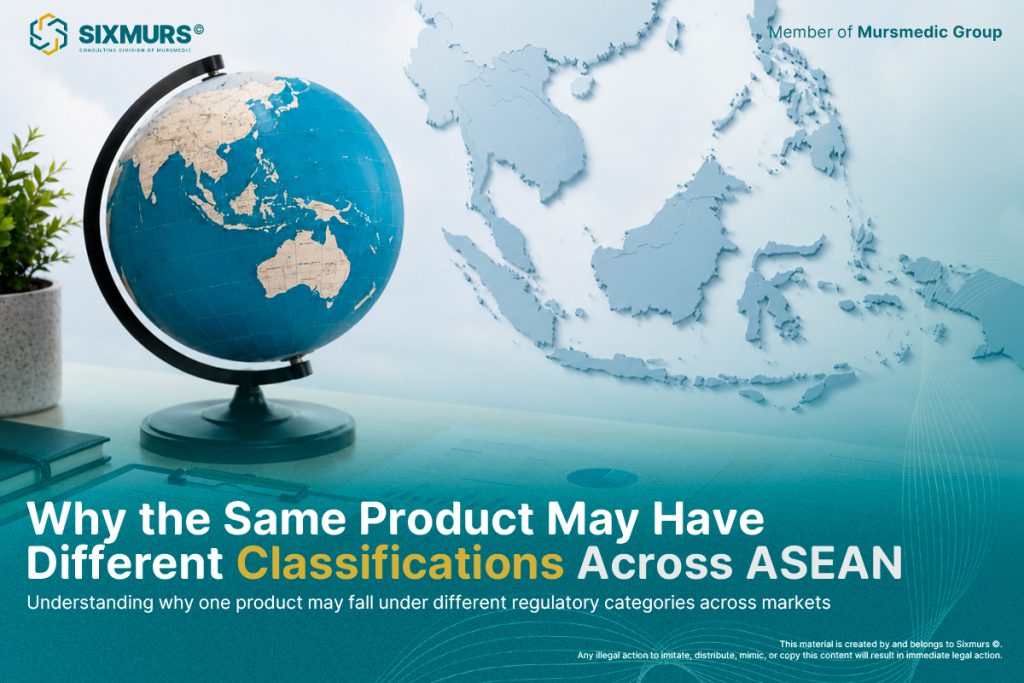
A product may be successfully registered as a medical device in one ASEAN market, yet follow a different regulatory route in another. In some cases, the same item may be treated as a medical device, an accessory, a spare part, or a non-medical product, depending on how the local authority assesses its purpose and characteristics.
The physical product may not have changed. Its regulatory identity, however, can.
This is one of the most important and frequently underestimated challenges in regional expansion. Assuming that a classification accepted in one country will automatically be accepted elsewhere can lead to the wrong submission pathway, unsuitable documentation, inaccurate budgets, and avoidable delays.
So, why does product classification across ASEAN vary, and what should companies do before entering multiple markets?
ASEAN Harmonization Does Not Mean Identical National Decisions
ASEAN Member States have established a common foundation through the ASEAN Medical Device Directive (AMDD). The framework includes shared medical-device definitions, four risk classes (A, B, C, and D) and the ASEAN Common Submission Dossier Template.
That harmonization is valuable, but it does not create a single ASEAN approval or remove national oversight.
Each country’s regulatory authority remains responsible for deciding whether a product falls within its jurisdiction, how the applicable rules should be interpreted, and what is required before the product can enter its market. The AMDD itself anticipates that a Member State may reclassify a device or apply the classification rules differently.
In practical terms: one regional framework can still produce country-specific outcomes.
1. Each Country Applies Its Own Legal and Regulatory Framework
The first question is not always, “Which risk class is this product?” It may be, “Is this product regulated as a medical device here at all?”
National authorities apply their own laws, implementing regulations, guidance documents, product-scope rules, and borderline-product policies. This can affect whether an item is considered:
- a medical device;
- an accessory with its own regulatory status;
- a spare part or component;
- a combination product;
- a general wellness or consumer product; or
- another regulated commodity.
This distinction matters because product classification and risk classification are not the same decision. Product classification determines which regulatory category and authority apply. Risk classification determines the level of risk, and therefore the level of regulatory control, once the item is confirmed to be a medical device.
Malaysia’s Medical Device Authority, for example, provides a formal product-classification process to determine whether a product is a medical device or a non-medical-device product under national law. Separately, its medical-device registration resources address the risk classification rules that apply once a product falls within medical-device scope.
2. Intended Use and Product Claims Can Change the Outcome
Classification is not based only on what a product is made of or how it looks. It is also shaped by what the manufacturer says the product is intended to do.
Under the AMDD, intended purpose is reflected in the product owner’s specifications, including the:
- product label;
- instructions for use; and
- promotional materials.
This means wording across a brochure, website, catalogue, packaging, or sales presentation can become regulatory evidence, not merely marketing copy.
Consider a connected sensor as a hypothetical example. If it is presented only as supporting general fitness awareness, it may be assessed differently from the same technology marketed to monitor, detect, or support the diagnosis of a medical condition. Singapore’s Health Sciences Authority likewise explains that medical-device classification considers intended purpose, how the device operates, its user, and the technology involved, while products intended only for general well-being may fall outside medical-device scope. See the HSA overview of medical-device classification.
A similar issue can arise with a replacement item. Depending on its function, claims, and relationship to the parent device, it may be regarded as a spare part, a medical-device accessory, or a device in its own right. The terminology used by a commercial team cannot decide this outcome on its own; the product’s actual role and the relevant authority’s rules must support it.
The lesson is simple: small wording differences can create major regulatory consequences. Product claims should therefore be reviewed before and not after labels, promotional materials, and registration dossiers are finalized.
3. Design, Function, and Use Conditions Affect Risk Classification
Even when multiple authorities agree that a product is a medical device, they must still determine its risk class. That assessment may consider factors such as:
- whether the device is invasive or non-invasive;
- duration of contact with the body;
- whether it is active, implantable, sterile, or measuring;
- the anatomy or physiological process involved;
- whether it delivers energy, medicines, or other substances;
- whether it is used by professionals or laypersons;
- the consequences of an incorrect result; and
- whether software drives or influences a clinical decision.
One model family may also contain variants with different features or intended uses. Treating every model as identical without checking these details can result in an incorrect grouping or risk-class rationale.
Thailand, for example, uses a four-class risk-based system aligned with the AMDD, but companies must still submit their classification and supporting information through the national process before registration. The Thai FDA’s official market-entry guidance links the assigned class to the applicable submission route.
4. Regulatory Interpretation Remains Country-Specific
Classification rules cannot anticipate every new technology, hybrid product, or borderline use case. Software, connected devices, aesthetic products, combination products, and accessories can be particularly dependent on interpretation.
Two authorities may begin with similar ASEAN principles yet reach different conclusions because of:
- different national guidance or precedent;
- different information submitted by the applicant;
- differences in local labels, claims, models, or configurations;
- different interpretations of the product’s primary intended purpose; or
- different treatment of borderline products and accessories.
This is why an overseas certificate or a classification from another ASEAN country is useful supporting evidence, but should not be treated as an automatic guarantee of the same local outcome.
Different Classification Means Different Market-Entry Requirements
Classification is not an administrative label. It determines the work, investment, and responsibilities required to enter and remain in a market.
| Classification Decision | Potential Business Impact |
|---|---|
| Regulatory category | Determines the responsible authority and whether product registration is required |
| Risk class | Influences the level of regulatory review and supporting evidence expected |
| Submission or evaluation route | Changes the application strategy and possible reliance on prior approvals |
| Product grouping | Affects whether models can be submitted together or require separate applications |
| Documentation | May change technical, clinical, performance, quality, and labelling requirements |
| Local representation | Can create country-specific license-holder, importer, or authorised-representative obligations |
| Timeline and government fees | Directly affects launch sequencing, budgets, and commercial forecasts |
| Post-market controls | Influences vigilance, reporting, traceability, change notification, and renewal duties |
Singapore provides a clear example of the commercial impact: HSA states that a device’s evaluation route determines the required documents, fees, and turnaround time. The route can also depend on the product’s risk class, prior approvals, and safe marketing history. See the HSA registration overview.
An incorrect classification assumption can therefore affect much more than the application form. It can disrupt the entire market-entry plan.
How to Assess Product Classification Before Expanding Across ASEAN
A stronger regional regulatory strategy begins before the first submission. Companies should conduct a structured, country-by-country assessment using the following steps:
1. Define the exact product configuration
Confirm the models, variants, accessories, components, software versions, packaging, and intended users included in the launch scope.
2. Align the intended use and claims
Review the intended-use statement, label, instructions for use, website, brochure, and other promotional materials. Claims should be consistent, supportable, and appropriate for each target market.
3. Separate product classification from risk classification
First determine the relevant product category and authority. If it is a medical device, assess its likely risk class, applicable rules, and rationale.
4. Map country-specific requirements
For each market, identify the expected pathway, local representative requirements, dossier gaps, labelling needs, government fees, estimated timeline, and post-market obligations.
5. Resolve uncertainty early
For borderline or novel products, consider whether a formal classification request or authority consultation is appropriate before investing in a full registration dossier.
6. Build the regional launch sequence around the findings
Prioritize markets based on regulatory readiness, commercial importance, documentation availability, and the possibility of using prior approvals to support later submissions.
One Product Needs One Strategy per Market
The same technology can create different regulatory obligations across ASEAN, not because regional harmonization has failed, but because harmonized principles still operate through national laws, local authorities, and country-specific implementation.
For companies expanding in Southeast Asia, classification should not be copied from one market to the next. It should be assessed deliberately in every target country, using consistent product information and a clear understanding of local requirements.
Getting the classification right at the beginning gives companies a more reliable view of their documentation, timeline, budget, and path to market.
Planning to Introduce Your Product Across ASEAN?
MURSMEDIC supports healthcare companies with country-specific product classification assessments, regulatory pathway mapping, documentation planning, product registration, license holding, and market-entry coordination across Southeast Asia.
Start with a clearer regulatory strategy before committing to your regional launch.
Connect with Mursmedic (Click the WhatsApp button on the bottom right corner):
Email: mkt.regional@mursmedic.com
Phone: +62 811-1929-2933
Website: www.mursmedic.com
LinkedIn: PT Mursmedic
Regulatory note: Product classification and registration requirements are subject to the applicable rules and final determination of the relevant national authority. Requirements may change over time.