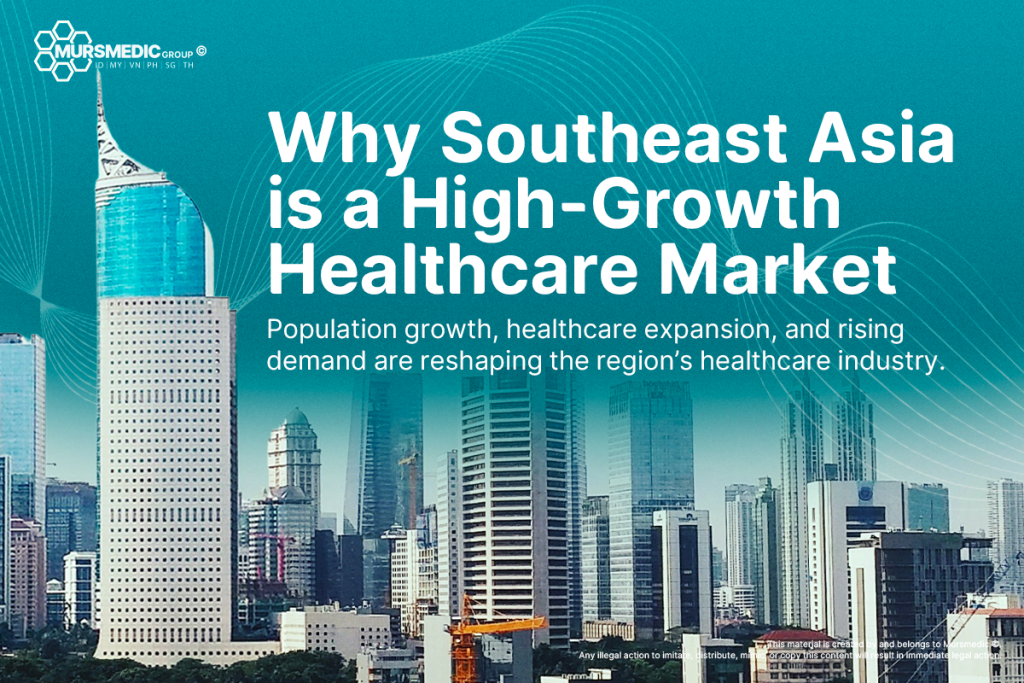
As healthcare demand accelerates across Asia, Southeast Asia has emerged as one of the world’s most promising regions for healthcare and medical technology companies. A rapidly growing population, expanding healthcare expenditure, broader universal healthcare coverage, and continued dependence on imported medical devices are creating substantial opportunities for companies looking to expand internationally.
However, successful expansion requires much more than obtaining regulatory approval. Every Southeast Asian country operates under its own healthcare ecosystem, regulatory framework, procurement process, and commercialization landscape. Companies that understand these differences are better positioned for sustainable long-term growth.
Southeast Asia’s Growing Population Continues to Drive Healthcare Demand

One of Southeast Asia’s greatest advantages is its demographic scale.
Indonesia alone has approximately 284.9 million people, making it the fourth most populous country in the world. Meanwhile, both the Philippines and Vietnam have populations exceeding 100 million, creating large and expanding healthcare markets.
In addition to population growth, many Southeast Asian countries continue to benefit from relatively young and economically productive populations. As income levels improve, urbanization increases, and healthcare access expands, demand for quality healthcare services, pharmaceuticals, medical devices, diagnostics, and hospital infrastructure continues to rise.
For healthcare companies, these demographic trends translate into long-term market opportunities across multiple healthcare sectors.
Healthcare Expenditure Continues to Increase Across the Region
Healthcare investment continues to expand throughout Southeast Asia as governments strengthen healthcare systems and private healthcare providers continue to grow.
Recent estimates show annual healthcare expenditure reaching approximately:
- Indonesia: USD 36.6 billion
- Thailand: USD 31.5 billion
- Singapore: USD 25.2 billion
Alongside increasing healthcare spending, governments across the region continue expanding universal healthcare programs to improve accessibility and healthcare outcomes.
Major national healthcare schemes include:
- Indonesia: JKN (Jaminan Kesehatan Nasional)
- Thailand: UCS (Universal Coverage Scheme)
- Vietnam: SHI (Social Health Insurance)
These initiatives continue to increase patient access to healthcare services while driving demand for medical technologies, healthcare infrastructure, diagnostic equipment, and innovative treatment solutions.
Southeast Asia Remains Highly Dependent on Imported Medical Devices

Despite continued growth in local manufacturing, many Southeast Asian countries still rely heavily on imported medical devices.
Estimated import dependency remains significant:
- Indonesia: approximately 76%
- Malaysia: approximately 88%
- Thailand: approximately 90%
- Philippines: approximately 95%
This high reliance on imported healthcare products creates substantial opportunities for international medical device manufacturers, diagnostics companies, and healthcare innovators seeking regional expansion.
However, entering these markets requires navigating country-specific medical device regulations, product registration requirements, quality management compliance, importation processes, local representation, and distribution networks.
Working with experienced healthcare regulatory consultants can significantly reduce time-to-market while supporting long-term commercial success.
Southeast Asia Is Not a Single Healthcare Market


Although Southeast Asia is often discussed as one region, each country operates independently with unique healthcare environments.
Every market has its own:
- Healthcare system
- Regulatory authority
- Medical device registration process
- Procurement structure
- Distribution network
- Commercialization strategy
- Market access requirements
A market entry strategy that succeeds in Indonesia may not be suitable for Thailand, Malaysia, Vietnam, Singapore, or the Philippines.
Building a Sustainable Healthcare Expansion Strategy in Southeast Asia
Healthcare companies entering Southeast Asia should look beyond regulatory approval alone.
Successful market expansion requires aligning regulatory strategy, market entry planning, commercialization, local partnerships, distribution, and long-term business growth. Understanding each country’s healthcare ecosystem enables companies to reduce market entry risks while creating stronger opportunities for sustainable expansion.
At Mursmedic Group, we support healthcare companies throughout every stage of regional expansion, including healthcare regulatory consulting, market entry strategy, product registration, quality and compliance consulting, importation and distribution, contract manufacturing, and commercialization support across Southeast Asia.
Whether you are launching a new medical device, expanding into multiple Southeast Asian markets, or developing a regional healthcare growth strategy, our team helps simplify complex healthcare regulations and accelerate market readiness.
Ready to expand your healthcare business across Southeast Asia?

Contact Mursmedic Group to discuss your healthcare market entry strategy and discover how we can help you navigate regulatory requirements, commercialization pathways, and sustainable regional growth. Click the WhatsApp button on the bottom right corner to book a complimentary meeting with our experts!
Source:
Worldometer—referred from U.N. Department of Economic and Social Affairs, Population Division (2025), Economic and Social Commission for Asia and the Pacific (2023), The World Bank, World Health Organization, OECD, Databoks, Kementerian Kesehatan Republik Indonesia, Badan Pengawas Obat dan Makanan (BPOM) Republik Indonesia, International Trade Administration, Encyclopaedia Britannica, Reuters, Indonesian Ministry of Trade (2026), International Monetary Fund (2024), “Governance in Southeast Asia: Issues and Options” (Philippine Institute for Development Studies), The Business Times, IMF Assessments (2025–2026), Ministry of Health (MOH) Singapore, MOF Singapore, SingStat, The Straits Times, Singapore Medical Association, Singapore Healthcare Statistics Databook 2024, Health Sciences Authority (HSA) Singapore, Singapore Government Procurement Portal (GeBIZ), Government of Malaysia, ASEAN Summit Reports, Regional Diplomatic Coverage (2025–2026), Ministry of Health (MOH) Malaysia, Statista, TradingEconomics.com, CodeBlue, HelgiLibrary.com, BusinessToday.com, Medical Device Authority (MDA) Malaysia, ePerolehan, National Pharmaceutical Regulatory Agency (NPRA), Election Commission Thailand (2026), Thailand National Statistical Office, TradingEconomics.com, Thai Food and Drug Administration, Ministry of Public Health Thailand, Government Pharmaceutical Organization (GPO) Thailand, Philippines Department of Health (DOH), Philippine Institute for Development Studies (PIDS), GeoJournal, PhilStar.com, RVAsia.org, Food and Drug Administration Philippines, PhilGEPS, ResearchGate, GA Capital, Chambers and Partners, The Saigon Times, VietNamNet News, Ministry of Health (MOH) Vietnam, Drug Administration of Vietnam (DAV), Department of Medical Equipment and Construction (DMEC), International Trade Administration (Vietnam Healthcare Resource Guide).